On October 21, 1959, the Solomon R. Guggenheim Museum opened on Fifth Avenue in New York. Visitors rode an elevator to the top, then walked down a single continuous ramp that coiled around an open rotunda, looking at paintings as they descended.
Frank Lloyd Wright had received the commission in 1943. Getting from sketch to opening took sixteen years. There were wartime material shortages, land to assemble, and long disputes with city building officials over a design that fit none of their categories. Wright was in his seventies when he began.
Not everyone wanted the building he drew. In 1956 a group of prominent artists signed a letter objecting that the sloping floor and curved walls were unsuited to showing paintings. Wright kept the spiral. Construction went ahead, and the concrete shell rose above the brownstones and apartment blocks of the Upper East Side.
Wright never saw the doors open. He died that April, six months before the museum admitted its first visitors.
The curators who had to hang flat canvases on his curved walls inherited the artists' argument without the one man who had insisted the building would work.
Checked against: Museum institutional archives, architect foundation records, contemporary New York newspaper coverage, published architectural histories and biographies
The coal board was to blame. The disaster fund paid the bill.
Illustration generated by AI for The Day Vault.
At 9:15 on the morning of 21 October 1966, a colliery spoil tip above Aberfan, in south Wales, gave way. Rain-soaked mining waste slid down the mountainside and into Pantglas Junior School, where lessons had just begun. It was the last day before the half-term holiday.
144 people died. 116 of them were children. Miners came up from the pits and dug beside parents with shovels and bare hands. After mid-morning, no child was brought out alive.
A tribunal found the National Coal Board wholly to blame. The tip had been built over springs, and local people had raised fears about the tips years before. Nobody at the Board was sacked, demoted or prosecuted.
The tips still towering over the village had to be removed. The government took £150,000 of the cost from the disaster fund, money the public had given to Aberfan's bereaved families.
The money was handed back in 1997, thirty-one years later, without interest.
Checked against: Report of the Tribunal appointed to inquire into the disaster at Aberfan (1967); UK parliamentary records; National Archives files; contemporary BBC and newspaper reporting; academic histories of the disaster
French women voted, and then the country voted twice more
Illustration generated by AI for The Day Vault.
On 21 October 1945, French women voted in a national election for the first time. The provisional government had granted them the right by ordinance in Algiers in April 1944, and they had first used it in municipal elections the following spring.
The October ballot asked more than one question. Voters chose deputies, and they also answered a referendum: should the Third Republic, the regime that had collapsed in 1940, simply come back? The answer was an overwhelming no. The deputies they were electing would sit as a constituent assembly and write a constitution from scratch.
Thirty-three women took seats in it. Many came out of the Resistance. No woman had ever sat in the French parliament before, because no woman had ever been allowed to stand.
The assembly wrote its constitution, and in May 1946 the voters rejected it.
France had to elect a second constituent assembly that June and start the draft again. The constitution of the Fourth Republic was finally approved in October 1946, a full year after that first ballot, and only narrowly.
Checked against: French national election archives, histories of the Fourth Republic, records of the 1944 Algiers ordinance on women's suffrage, National Assembly historical membership records
Britain won the sea. The war had already moved inland.
Illustration generated by AI for The Day Vault.
On 21 October 1805, off Cape Trafalgar on the Spanish coast, 27 British ships of the line under Vice-Admiral Horatio Nelson attacked a combined French and Spanish fleet of 33.
Nelson split his ships into two columns and drove them straight at the enemy line to cut it apart. It was a gamble. During the slow approach, his leading ships took broadsides they could barely return. By late afternoon the allies had lost 22 ships. Britain had lost none. Nelson did not see the end. A French marksman's musket ball struck him on the quarterdeck of HMS Victory, and he died below decks hours later, after being told the battle was won.
At home, Trafalgar became the victory that saved Britain from invasion. It brought a state funeral, decades of anniversaries and eventually a column in the middle of London.
But Napoleon had already given up on invading. His army had broken camp on the Channel coast in late August and marched east, and that same week it took the surrender of an entire Austrian army at Ulm.
Six weeks after Trafalgar he crushed Austria and Russia at Austerlitz. Britain now ruled the sea. For another decade, Napoleon ruled the land.
Checked against: Royal Navy logs and dispatches from the battle, Admiralty records, standard naval histories of the Napoleonic Wars, and maritime museum collections
He described what was above him. Then the radio filled with noise.
Illustration generated by AI for The Day Vault.
On October 21, 1978, a 20-year-old pilot named Frederick Valentich took off from Moorabbin airport, near Melbourne, in a small Cessna. He was heading across Bass Strait to King Island. It was early evening, and the weather was fine.
Over the water, he radioed Melbourne Flight Service. He reported a large aircraft with bright lights passing close above him. The controller told him there was no known traffic at his level. Over the next several minutes Valentich described the thing circling, then sitting over him, and said it was not an aircraft. He reported that his engine was running roughly.
His final transmission was cut off by a stretch of harsh metallic noise. Then the frequency went quiet. Air and sea searches found no wreckage and no pilot. The official investigation could not determine why the aircraft disappeared and presumed the crash fatal.
Valentich was also a keen follower of UFO reports, relatively new to flying at night, and alone over black water, which are exactly the conditions in which a pilot can mistake stars, distant lights or his own reflection for something following him.
No wreckage has ever been identified, so that explanation has never been ruled in, and no other has ever been ruled out.
Checked against: Australian Department of Transport aircraft accident investigation summary; officially released transcript of the radio exchange; contemporary Australian newspaper reports; later aviation-safety and historical accounts
They marched out for Nicaea's riches. Their preacher was in Constantinople.
Illustration generated by AI for The Day Vault.
On 21 October 1096, Turkish forces destroyed most of the People's Crusade near Civetot, a camp on the Asian shore not far from Nicaea. Most of the dead were not soldiers. They were farmers, townspeople and families, with a scattering of knights, who had walked from France and the Rhineland after the Pope called for Jerusalem to be taken.
They had set off months ahead of the organised armies. In August the Byzantine emperor Alexios ferried them across the Bosphorus, away from his capital. At Civetot they waited, raided the surrounding villages and quarrelled among themselves.
A German contingent seized a fort called Xerigordos and was besieged there until it surrendered. Soon afterwards a rumour reached the camp that the Germans had taken Nicaea and were sharing out its wealth. The crusaders marched out to claim their part. Turkish archers were waiting in the hills along the road. Survivors held out in an old fortress by the sea until Byzantine ships arrived to take them off.
Peter the Hermit, the preacher who had led many of them east, was not there. He was in Constantinople, asking the emperor for help.
He survived. Three years later he was with the princes' armies when they took Jerusalem.
Checked against: Chronicles of Albert of Aachen and the Gesta Francorum; Anna Komnene's Alexiad; standard academic histories of the First Crusade
He brought in the violins. The best-known of those songs came out after the crash.
Illustration generated by AI for The Day Vault.
On October 21, 1958, Buddy Holly walked into Decca's Pythian Temple studio in New York and recorded with an orchestra. Eighteen musicians, most of them string players, sat where a drum kit and two guitars usually stood.
Arranger Dick Jacobs led them through four songs: "True Love Ways," "Moondreams," "Raining in My Heart" and "It Doesn't Matter Anymore," a tune Paul Anka had written for him. Holly sang live with the strings. Rock and roll singers were not supposed to sound like this, and he wanted to find out whether he could.
It looked like the start of a second career. That autumn he had split from the Crickets and from his producer, Norman Petty, and moved to Greenwich Village with his new wife. He talked about acting, about producing other singers, about more records like these.
But the break with Petty left his royalties tied up, and by Christmas Holly needed cash. He signed on for the Winter Dance Party, a bus tour through the frozen Midwest.
On February 3, 1959, the light aircraft he chartered to escape the bus crashed near Clear Lake, Iowa. That April, "It Doesn't Matter Anymore" went to number one in Britain.
The film picked the Cubs. The Mets had other plans.
Illustration generated by AI for The Day Vault.
On October 21, 2015, the future arrived on schedule. It was the date Marty McFly lands in when he travels forward in time in Back to the Future Part II, the 1989 sequel. Fans had been counting down for years.
The film had made a cheerful bet. In its version of 2015, the Chicago Cubs sweep a Miami team to win the World Series. The joke worked twice. Miami had no major league club in 1989, and the Cubs had not won a championship since 1908.
Then the real 2015 started cooperating. Miami got its team in 1993. The Cubs had their best season in years and reached the National League Championship Series. Theatres replayed the film, and fans wore self-lacing sneaker replicas to Wrigley Field.
On the very evening the film had promised, the New York Mets beat the Cubs 8-3 at Wrigley Field and finished a four-game sweep.
Chicago went home in October as usual. The following autumn, a year late and with nobody's script, the Cubs won the World Series.
Checked against: Major League Baseball box scores and postseason records; contemporary newspaper sports coverage; the film's release history and screenplay
Philadelphia finally won. The police horses were already on the field.
Illustration generated by AI for The Day Vault.
On October 21, 1980, the Philadelphia Phillies beat the Kansas City Royals 4-1 at Veterans Stadium to win the World Series in six games.
It was the club's first championship. The franchise had been playing since 1883 and had reached the World Series only twice before. It lost to Boston in 1915 and to the New York Yankees in 1950. By 1980 it was the last of baseball's sixteen original-era franchises still without a title.
Tug McGraw came in from the bullpen in the eighth inning to protect the lead. In the ninth he loaded the bases, got a foul pop-up for the second out, then struck out Willie Wilson. He jumped off the mound with both arms in the air.
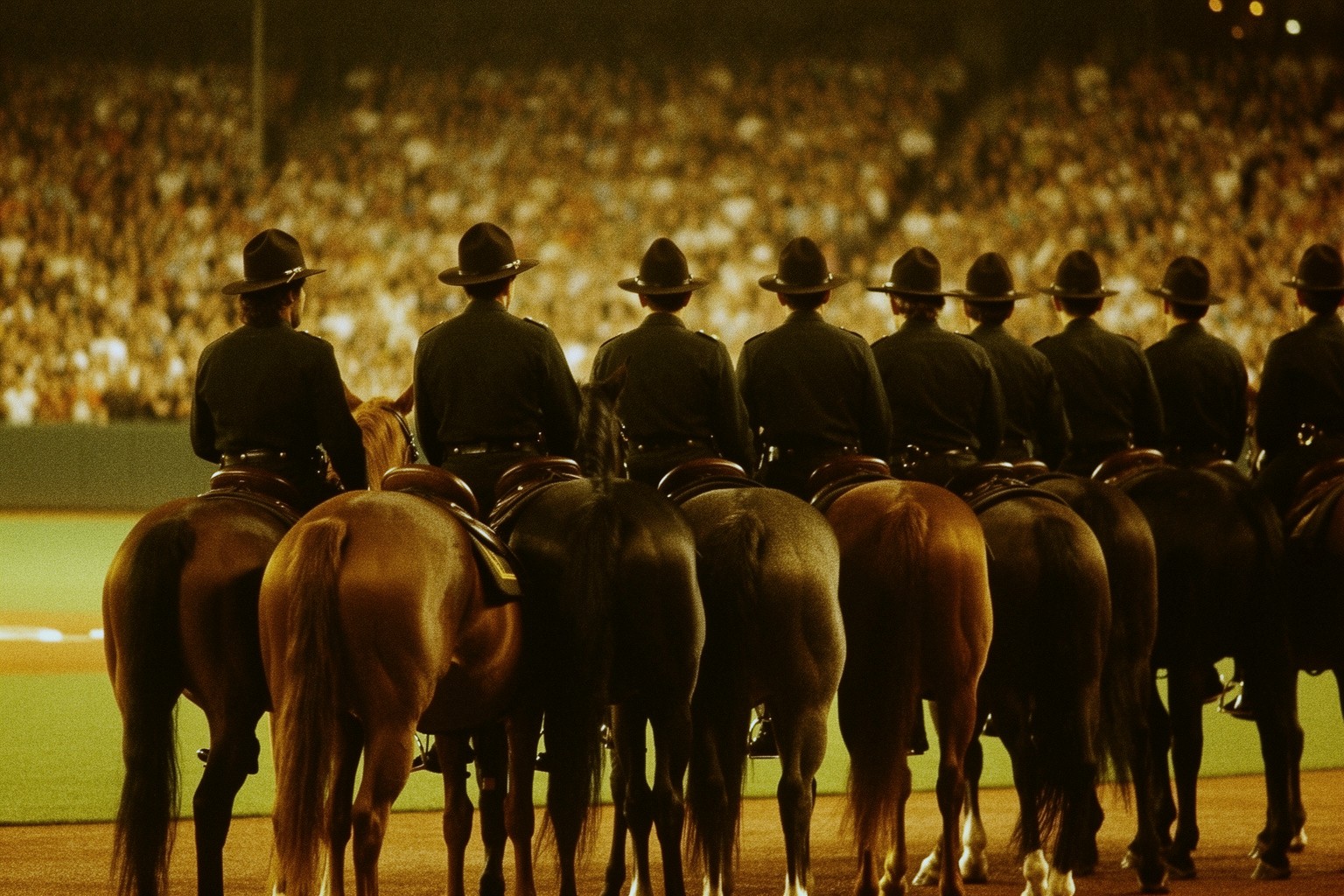
The city had not trusted itself with the moment. Before the last pitch, mounted police and officers with dogs had taken up positions along the edges of the field.
So ninety-seven years of waiting ended inside a cordon. The players piled onto each other on the grass, and the crowd cheered from behind a line of horses.
Checked against: Contemporary newspaper game reports, official Major League Baseball records and box scores, broadcast footage of Game 6, franchise histories of the Philadelphia Phillies
The metre was tied to light. Light's speed could no longer be measured.
Illustration generated by AI for The Day Vault.
On 21 October 1983, delegates at the General Conference on Weights and Measures in Paris redefined the metre. From that day it was the distance light travels in a vacuum in 1/299,792,458 of a second.
The metre had been rebuilt before. From 1889 it was a platinum-iridium bar kept at Sèvres, outside Paris, with copies shipped to national laboratories around the world. In 1960 it became a count of wavelengths from the orange-red glow of a krypton lamp: 1,650,763.73 of them.
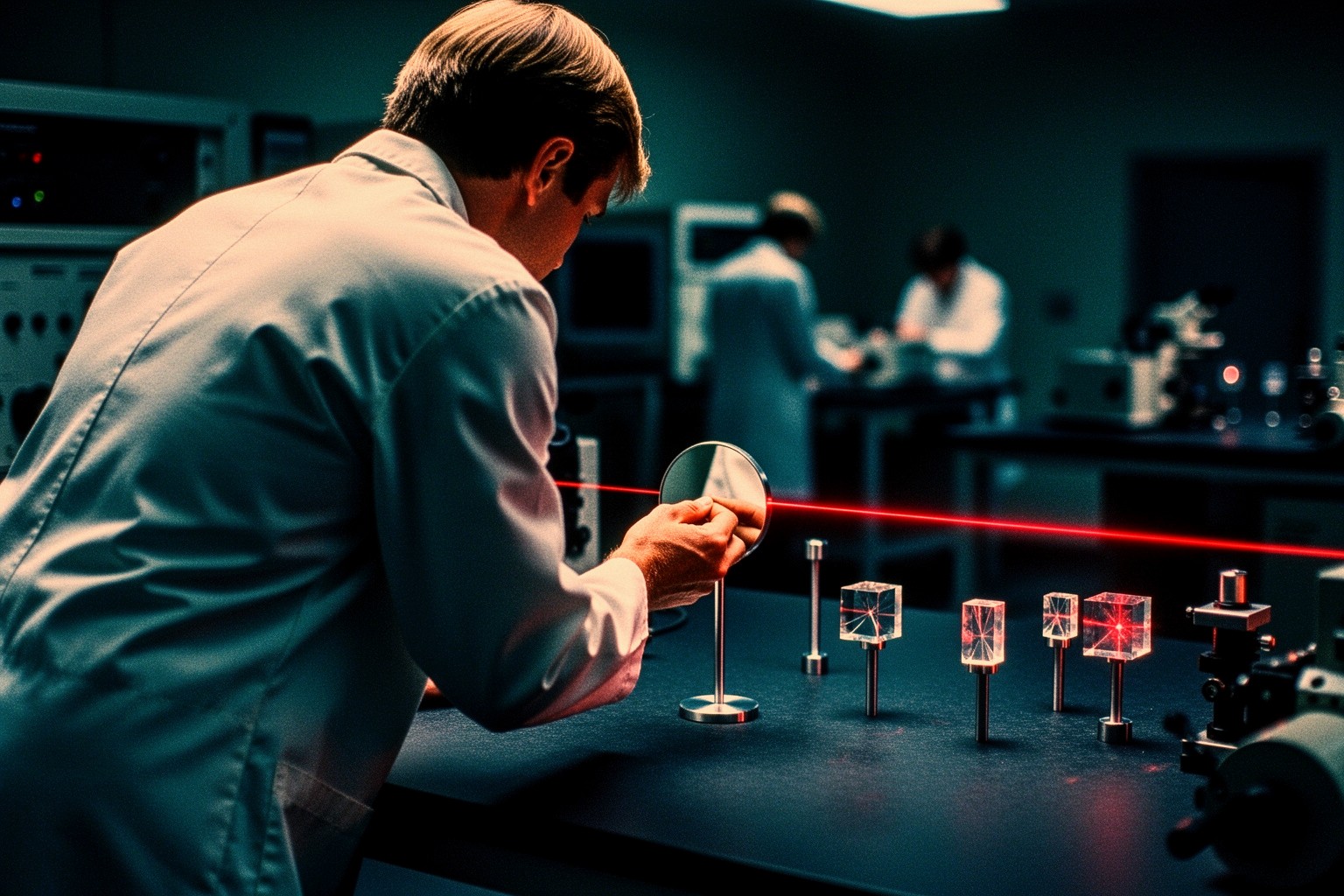
By the 1970s, lasers let physicists time light more precisely than anyone could mark out a metre. The weak link was the ruler, not the clock. So the conference tied length to time, which atomic clocks already kept better than any other quantity in physics.
The price was that the speed of light stopped being something anyone could measure.
It is exactly 299,792,458 metres per second because the metre is defined that way. A sharper experiment today does not refine the speed of light. It refines the metre.
Checked against: Resolutions of the 17th General Conference on Weights and Measures (1983); International Bureau of Weights and Measures historical publications; national metrology institute histories; physics reference texts on the SI system
They found the passage. Their biggest ship went home.
Illustration generated by AI for The Day Vault.
On 21 October 1520, Ferdinand Magellan's fleet rounded a headland near the southern tip of South America and found a gap in the coast. It was the feast of St Ursula and her eleven thousand virgins, so the point became Cape Virgins. It still carries the name.
The Spanish crown had sent him to find a western sea route to the Spice Islands. Five ships had left Spain in 1519. One had since wrecked off Patagonia. A mutiny that spring had ended with one captain killed, one executed and another marooned.
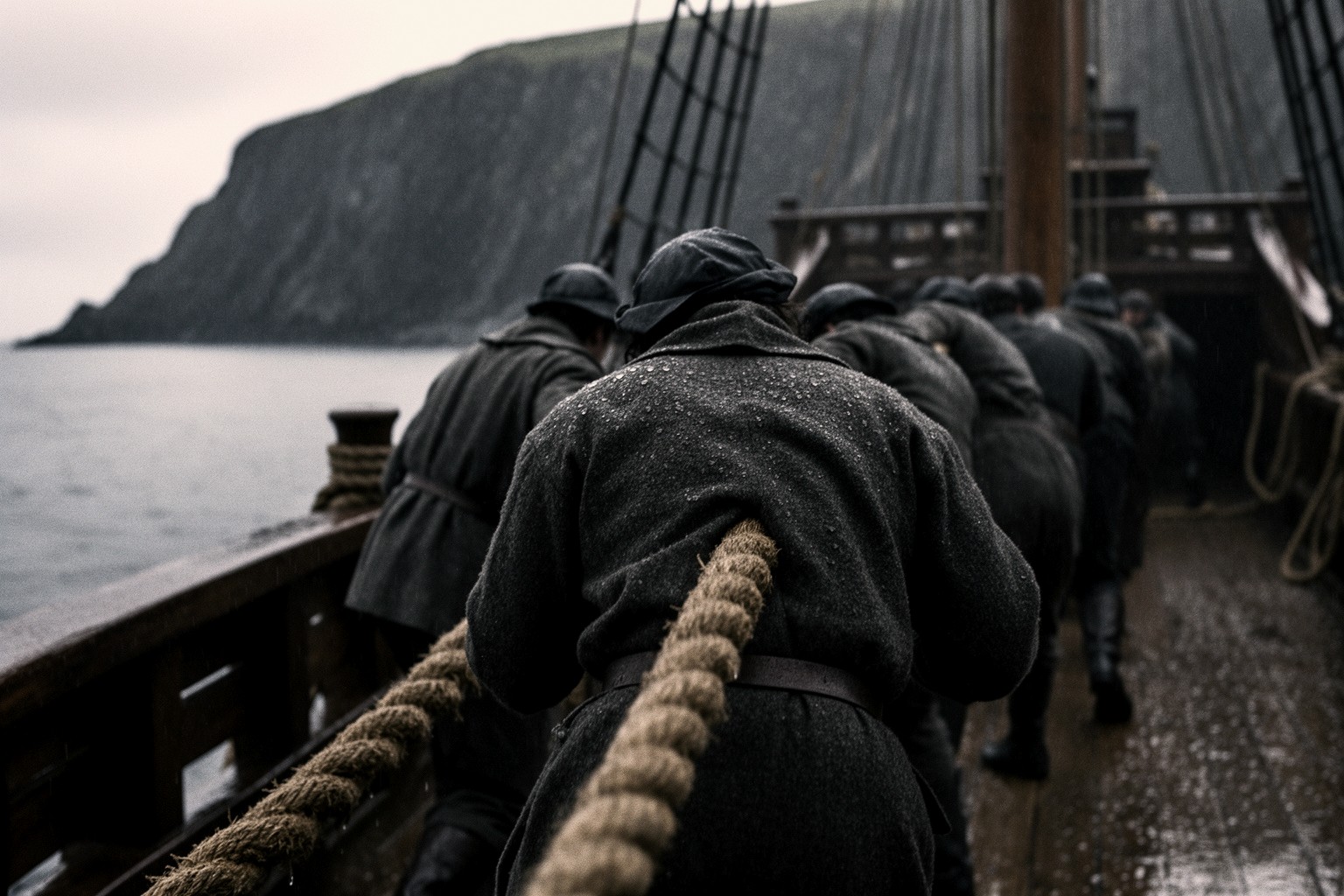
The four remaining ships spent weeks feeling their way through a maze of channels, between steep, dark shores in cold water. At night the sailors saw fires burning on land, and called the place the Land of Fire.
Somewhere in that maze, the San Antonio, the largest ship in the fleet and the one carrying much of its food, slipped away and sailed back to Spain.
The other three ships came out into the Pacific on 28 November. They then sailed for more than three months without fresh food. By the end, the crews were eating rats, sawdust and the leather wrapped around the yards.
Checked against: Antonio Pigafetta's eyewitness account of the voyage, Spanish crown records from the Casa de Contratación, and standard scholarly histories of the Magellan expedition